Showing posts with label chicken keeping. Show all posts

Monday, August 20, 2012

The Great Egg Caper

For awhile now I have not been letting the hens out of their run until I would find an egg in the nesting box - or at least until sufficient time had passed to where there normally would be an egg.  Since the egg production has been quite spotty as of late, I wasn't expecting anything this morning.  However, I was intrigued as I approached the coop, and Beulah seemed excited (or agitated) for me to be there.  She hopped up into the coop, and as I opened the door to the nesting box, was happy to find an egg in there.  I also found Beulah poking her head out, and making her chicken sounds.  I thought she was just anxious to get out of the run.

Well, she truly was anxious to get out of the run, but not for the reason I thought.  They really don't like being cooped up in the three foot by six foot run all day.  So, I thought she was just anxious to get out and forage around the yard.  I opened the door to the run, and they both scurried out.  I didn't think anything of it, and set out to move the coop.  I remove the hanging water container so it doesn't spill all over during the move.  I  was preoccupied for a few minutes getting everything set again.

I then heard the chicken sounds from around the house, but couldn't see either hen.  I looked under the back entryway where they like to go in the heat of the day.  They weren't there.  I then looked over by the garage and garden.  Not there, either.  I then spotted a cat meowing a couple of houses away from ours, and decided to see if I could get it to come over.  All the while I'm hearing the chicken cooing sounds coming from the back of the house.  After spending a minute or two scratching the cat's head, I decided to go and find who was making all the noise once and for all.  I went back and looked under the entryway, and still no chickens were under there.  I finally decided to look in the bushes next to the rear stoop.

Egg stash under the bushes.
The start of a nest
Sure enough, Beulah was just lying there under the plant leaves.  I thought that was odd, since it is nice out this morning, but by no means was it hot out.  They usually like to sit in the bushes like that when temps get into the 80's or 90's (f).  She wasn't acting like she normally does when she is egg-bound, so I that wasn't the issue.  I finally just let her know that I was going to see what she was sitting on.  Lo and behold she had a stash of four eggs under there.  No wonder she was so anxious to get out of the coop.

Close up of the four eggs in the nest.
Close-up of the rogue nest.
I've read about broodiness in hens, and since we are relatively new to keeping chickens, we had not really experienced it to speak of.  Sheri once told me that Henrietta was wanting to stay on the eggs in the nesting box one time last fall or winter, but that was about it.  Well, Beulah was certainly displaying full-out broodiness today.  We'll have to keep an eye on that for a few days until we can get her past it.

I guess with chickens you never know what is going to happen from day to day.  I also learned to be more observant, and not get into just a routine when checking for eggs and looking after the hens.

Tuesday, August 14, 2012

Summer Egg Production

Or should I say Summer egg NON-production?  First of all, I cannot believe it's been almost two months since the last post.  I meant to get back within the week, but I guess life got in the way.

Egg production has been extremely spotty throughout the entire summer.  One day we'll get one egg, then it might go a few days before getting another.  Once in a great while we would have two eggs, but that has been rare.

Henrietta on left, Beulah on right
Now, we are quite certain that the hens have gone into molt.  First it was Beulah, then Henrietta started, but they weren't one right after the other, it was more like a matter of weeks passing before Henrietta really started.

  If anyone is curious how to tell if their chicken is molting, there are a few tell-tale signs.  First, you will see an excess of feathers on the ground and in the coop.  Then the chicken that is molting will start to look scraggly (the best way I can describe it).  I mean, after all if they are losing feathers they won't look all filled out.  It's been most notable on their necks.
Note the sparseness of feathers

 So, how do feathers come back in after they lose them?  It's pretty interesting really.  The quill part of the feather will grow first, then the feather continues to get longer, and the plumage starts to protrude out the end.

Quills forming on wing
Beulah has had a couple of episodes of being egg-bound for which we took prompt action.  If she absolutely cannot get the egg out on her own, then we will put her in a bath of warm water, massage the vent area with the warm water, and let her sit for awhile.  Eventually the egg will come out.  We also work to hydrate her, and replace electrolytes.  We've found the best product to use is SunRider's Fortune Delight.  It has other beneficial properties as well.  (It is an herbal drink for humans, but has all necessary electrolytes and other properties necessary for the hens as well.)  I have been giving them extra egg shells or oyster shells in their feed to try and keep them from getting egg-bound.  We haven't had an episode in several weeks now.

Quills forming on her back
Lately, though, they've been very happily clucking and scratching around the back yard.  So, they're in good health.  They love treats - anything from watermelon rinds to tomatoes, grapes, raspberries, and more.  One treat I discovered quite by accident today.  I was cleaning their coop out.  When I removed the nesting straw, I found there were several earwigs underneath.  They started dropping through the slot under the nesting box, and into the run.  Henrietta found them almost immediately and gobbled them up.

That reminds me of a funny thing that happened just a couple of days ago.  I had found a large spider (large for around here might be half an inch in body size.  This spider was sort of spotted.  I went into the house to get a jar to capture it.  Of course, anytime I'm working around the backyard the nosy hens are right there.  They might miss out on a tasty morsel otherwise.  Well, true to form the spider dropped to the ground while I was trying to capture it.  Before I could reach down to grab it, Henrietta gobbled it down.  I could only laugh.  I really wanted to photograph the spider and figure out what species it was.  I guess I'll have wait until next time.

Oh, and the hens also like LOVE slugs.  I feed them this treat whenever I find them on plant leaves and such.  I've noticed that they really love to hang around the raspberry bushes.

Next up will be a video of leaping chickens.  They love dried worms, and wait until you see what they will do to get them.

Saturday, June 23, 2012

The Mystery Is Not Yet Solved

Can you tell which is the jumbo?
Today officially marked two weeks since we received the new, organic, non-soy layer mash.  I had hoped it would do the trick on getting the hens back to regular laying.  However, there were no eggs, except for some dropped ones around the yard, for the next couple of days.  Then, I found one large diameter egg next to a normal sized one (see photo).  I thought things might be getting back to normal.  (In the future I'll put a ruler next to the eggs for reference.)

Well, we had two eggs for the next couple of days, but then the production started becoming spotty again.  Then, this past Thursday evening Beulah was just sitting among the raspberry bushes and not doing much of anything.  If it was a hot Summer mid-day I wouldn't have thought anything of it.  However, at evening time they would both generally be still wandering the yard looking for juicy bugs or getting ready to go in for the night.

I asked Sheri to come and look, and she seemed to think that is how Beulah was acting the time she was egg-bound.  We decided to bring her in and put her in a warm bath.  She fussed a little, but not much.  She definitely was not acting herself.  After awhile we saw her eliminate a bit of liquid from her behind.  Sheri thought it was egg white, but to me it just seemed to be regular, milky chicken doody. We put her back outside, and she began to walk around again.  It was time for bed, so she pretty much went into the coop right away.

The next morning (Friday), when I went to open the door to the coop, I looked inside and saw a very milky blotch (about the size of a dropped egg without the shell) on the paper under the roosting bars.  I wasn't sure what to make of that.  Well, Beulah came out of the coop a bit more slowly that morning, and was acting rather listless.  She would just stand in one spot for extended periods of time without moving.  I watched her do this for a few hours, then finally decided to bring her back into the house and get her in a warm tub of water.  This time I filled the tub almost full.  I wanted her bottom to be bathed in the warm water for awhile. I found, however, that she had some trouble standing with so much water.

The weird egg blob.  Sort of
looks like an aborted fetus, no?
In the meantime, while the tub was filling, I massaged her vent area, then stuck a finger up there a ways to see if I could feel an egg or anything.  I didn't want to go in too far, but didn't feel anything.  It did feel very warm, and wondered if that was normal.  I drained most of the water, then finally all of it.  I left her standing in the tub for maybe 30 minutes, checking on her periodically.  One of the times when I went in to check, I found she had eliminated a peach colored blob (see photo).  I could tell it was an egg shell.  It was apparently stuck in the canal somehow.  She then had more of a normal dropping.

I figured she must feel much better, so I took her back outside.  She started walking around the yard again, picking up food.  Then I saw her standing under our back pantry area (no foundation under it) for awhile not moving again.  When I went out later to mow the lawn, she was going around the yard making her usual clucking sounds.  I figured she got out whatever was bothering her.  I observed her go into her run to eat and drink water.  Water, by the way, which I have been refreshing every couple of days, and adding a couple of tablespoons of Bragg Apple Cider Vinegar.

Then, this morning she was slow to exit the coop again.  She did come out and go right for the food and water.  I observed her drink some water.  There was only one egg in the nesting box, so I just figured that from what Beulah went through yesterday, she must be strained, and needing a break.  When we let the hens out of the run, Beulah was acting her normal self, and out foraging for goodies.

Since Beulah seemed to be back to her normal self, we decided to go on a short motorcycle trip we had planned to make.  We were gone most of the day.  Upon returning (in the rain), I went back out to find the chickens, and found Beulah under the pantry/back entry way again.  This time she was standing and not sitting.  I went back about ten minutes later, and she was still there.  I tried to reach under to grab her, and she ran.  That was more normal than not normal.

I went about doing the gardening chores I needed to get done.  Henrietta came over to shadow, and see what I was doing.  Beulah did not.  I checked on her about twenty or thirty minutes later, and she was walking out from under the back entry.  I went to pick her up, and she evaded me.  That seemed normal as well.  I finally tried one more time about fifteen minutes later, and had a difficult time, but did succeed in catching catching her.  I asked Sheri to take her and do the warm bath routine again.  She emerged with a wet hen awhile later, and said she wasn't cooperating.  She released the bird.

At around 7:45 pm, I suddenly heard Beulah making her loud clucking sounds (see the video from a couple weeks ago to see what I mean).  She was standing on the ladder to the coop, then went in.  Now that was odd.  She stayed in there.  Henrietta, of course, continued to peck around the yard until near dark when I finally shooed her into the run.

So, here's where we stand: 1. Beulah was definitely having an issue on Friday, but seemed rather normal today.  2. There was only one egg this morning, obviously from Henrietta.  Oh, and by the way, Beulah sat in the coop quite awhile this morning while Henrietta sat in the nesting box.  This was also not normal.  3. Beulah is definitely having an issue of some sort, but we're not able to determine exactly what it is.

One theory I have is that since the hens were eating the old feed while it continued to go sour, their systems got used to it.  When the new feed was introduced, Henrietta readjusted right away, but Beulah has not.  I don't know if I'll be able to prove that theory, but I'll keep everyone posted as to what happens next.

Note the crack on the left egg.
P.S. The week prior to getting the new feed, Beulah laid an egg with sort of a crack in the shell.  See the photo for a better explanation.


Friday, June 8, 2012

Egg Drops or The Soft Shell

Soft egg next to garden
Chicken keeping  -  So lately we've been running into an interesting situation with the egg production from our two hens.  We'll go for several days with an egg from each per day, then one day we'll just get one egg.  Later I would be walking around the yard, or the garden and find a soft egg deposited somewhere.

One day, several weeks ago, Sheri called me up and said Beulah was acting rather strange (I was not home at the time).  She said the hen was not making her normal clucking sounds, and was just sort of standing there.  Then she went into the run and just stood in front of the ladder not making any attempt to jump up and go into the coop.

I dug into it a little, and learned that a chicken can act like that if she is egg-bound.  So, I said to Sheri that she needs to take the hen into the house, and draw up a bath of warm water.  Then she needs to massage the vent area with the water to try and loosen up the egg.  Needless to say, Sheri was rather worried - especially since we lost Nellie back in November.  I'm now rather certain that it's because she, too, was egg-bound at the time, and died trying to get it out.  It's a sad feeling knowing that we could have done something had we known a bit more.

Next, I read that in a situation such as this the bird needs to get some electrolytes as soon as possible.  I could not think of anything we had around the house that had electrolytes, so I told her she had to go to the store and pick up some Pedialyte.  The store is just a few blocks away, and she hurried out to get some.  In the meantime she barricaded the bathroom (mostly so the cats wouldn't go in snooping around, and left Beulah in the warm tub.  When she returned she found egg parts in the tub.  The warm water apparently worked, and she passed the egg.

Soft egg dropped in the coop (under the roosting bars - viewed from above)
Soft shelled egg under
roosting bars (view from
above)
Sheri worked to get some of the Pedialyte down her beak, but it wasn't going well.  She said the hen started to sound her normal self, so the crisis was over.  Afterwards we found out that we actually DID have something we use every day that has electrolytes in it.  It's called Fortune Delight, a wonderful organic, herbal drink by Sunrider International.  We're Independent Business Owners (franchisees, if you will) of this company.

So, the issue with the soft eggs being dropped regularly around the yard is still plaguing us.  I decided to do some checking into the feed.  We've been feeding our chickens organic, non-soy layer mash from CFS Specialties, Inc.  Up until now it's been great.

Close up of a soft shelled egg
One of the things I discovered is that soft eggs sometimes come from the chicken experiencing sudden shock, but most of the time a cause cannot be found.  From Omlet's Wiki: "It is quite common for a hen to very occasionally lay a thin-shelled or soft-shelled egg. A few hens do this for a short while and a very few may do this for several weeks.

This is extremely unlikely to indicate a problem with a hen. The one-off dodgy egg is just a blip in the egg production system, possibly caused by a shock, but usually no cause can be found."


Another possible cause of the soft shell egg is not getting enough calcium in the hen's diet.  Now, the CFS Specialties layer mash is supposed to have all nutrients and food needs for a hen to be a good layer.  But, the feed is old, so I took some saved egg shells, pulverized them and added them to the feed.  It didn't seem to be making a lot of difference.


Then, through more investigation, I found out that the nutrients in the feed begin to break down after about three months.  Well, since we had purchased this fee back in July last year, this could be the biggest culprit.  It's nearly a year old!


I am picking up some fresh organic, non-soy layer mash from Nature's Grown Organics via JR's Farm and Garden of Crystal Falls, MI.  Hopefully we'll know within the next week if that changes things.  Keep your fingers crossed.

Tuesday, September 13, 2011

The Inauspicious Beginnings of Our Chicken Ranching

Welcome to the beautiful land of the Upper Peninsula of Michigan! It's my favorite place in the whole wide world. Has been ever since I was a youth. Well, I'm finally getting started with this blog to chronicle our (my wife and I) journey into the world of urban farming. We don't live in a metropolitan area, but we're still in the city of Iron River, MI. So, it's still urban. We have less than 1/4 of an acre of land, and last year decided to become more self sufficient.

We purchased our house in 2009 for just over $25,000. It was in live-in condition, but being the restless spirits we are, we decided to do a bunch of remodeling - gutted and remodeled the kitchen, gutted and remodeled both bathrooms, gutted what we use as the master bedroom, new carpeting throughout, several new zo-e-shield windows, added insulation to the attic, rebuilt the chimney, replaced and moved the water heater, installed a wood furnace, and put up additional food and emergency storage.

 Then, over the Winter this past year, we decided to delve into raising our own chickens. The decision was to harvest our own organic eggs. We did some research into Chicken Coops, and found that a Chicken Tractor was our best bet. After doing more research, we decided the Eglu Cube by Omlet was the way to go. It is not an inexpensive solution, but being made of a high grade of plastic, and being quite modular in design, it is easy to clean, care for, and keep pesky pests away from our chickens. So, in March or April we actually placed our order for the Cube. It comes from England, and they only ship periodically, so we needed to get into the queue to receive ours. We had a lot of preparation to get ready for the chickens anyway. We needed to fence in the back yard (we had already made the decision to do an organic garden as well), and wanted mostly to keep the deer and other large animals out.


North fenceline & tilled garden.
South and Southwest fenceline
South and slightly East
East Fenceline
I heard someone on a local call-in radio program who had a lot of cedar posts that I could purchase for a reasonable price. I went and picked up about 40 of them. In mid-May, I took a week off work, and planned on getting the fence in, the wind generator up, and a whole lot of other tasks. I highly under-estimated my work load. Turns out the ground was still frozen in some spots. As I began digging the holes, I hit something solid. I thought it was just hard, rocky soil (we are in iron country after all). After trying a second hole, and hitting the same thing, I determined it was going to be necessary to use a power auger. So, I went and rented one. After having a hard time drilling the first hole, and inspecting what came out, I realized it actually was frost I was hitting. Fortunately, there were only three holes that were frost ridden - places where the sun did not shine much. The rest was a piece of cake. I'm glad I had the power auger, though. It went much faster.

Well, at the end of that week, I had only gotten 3/4 of the fence posts placed, and no fencing put up.  I had to work frantically the next couple of weekends in order to finish up the fence, and build the gates.

Eglu Cube as shipped.
Inspecting each box.
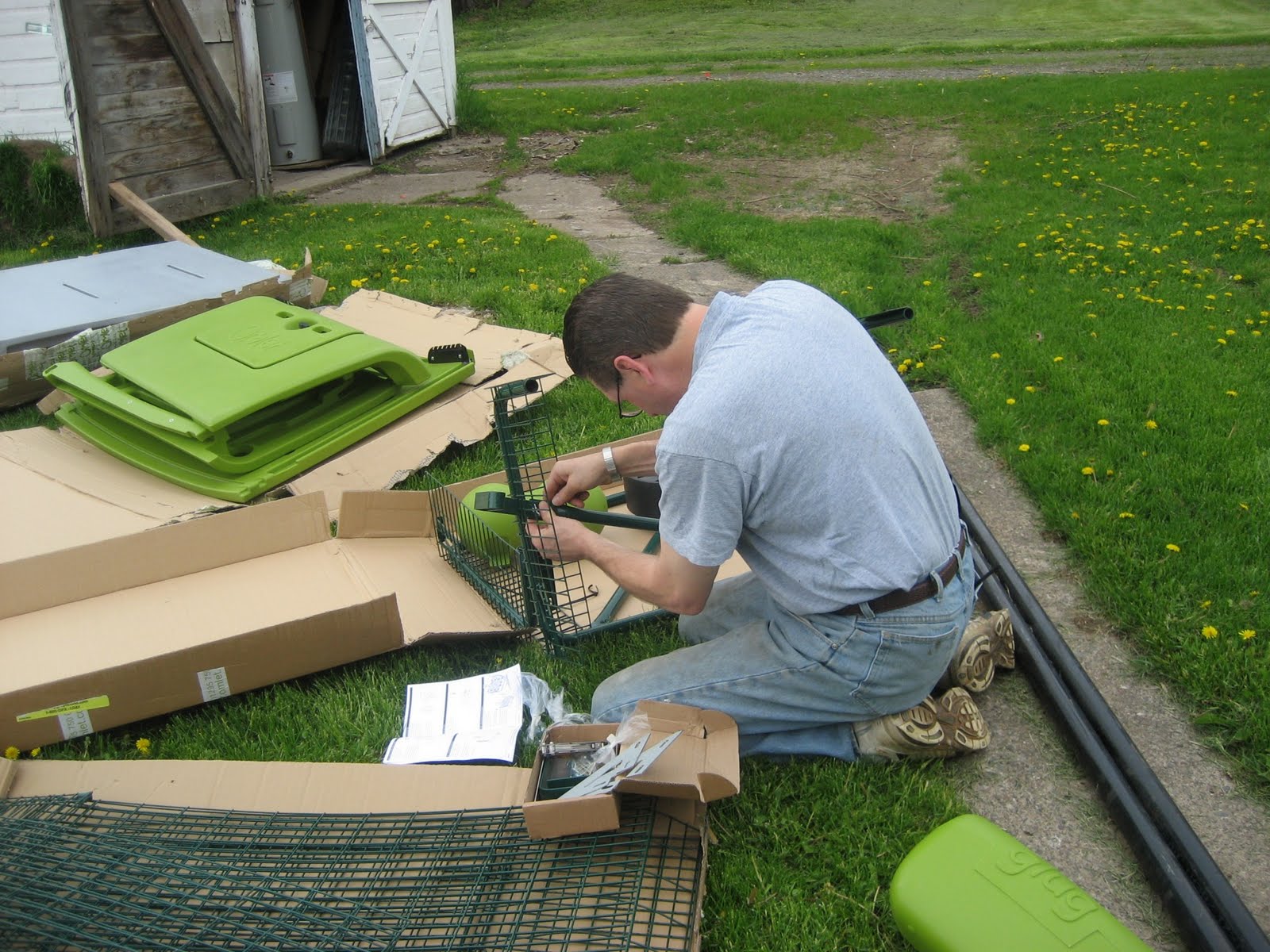
After some rather disconcerting issues with the shipping company (Greyhound), the Cube finally showed up. I was home the weekend it was supposed to be in, but only one box came.  Sheri had to go get the rest of them when they finally arrived at the Iron Mountain depot.  It came in five large boxes.  I decided to document step-by-step putting it together, figuring it might be a useful tutorial for Omlet.

Everything is there.
Retrieving the first pieces to assemble
After inspecting each box to make sure there was nothing missing (some of the boxes had some good sized holes in them), I looked over the instructions.  They said it would take a few hours to assemble.  Sheri thought I was nuts to have her take a photo of each step, but I like to be helpful, and if it can help even one person it's worth it.  Besides, I had fun doing it.

Putting together the wheel assembly.
Installing the supports to the base.
Assembly was pretty straight-forward, as long as you closely followed the instructions.  There were a couple of times when I had to scratch my head before figuring out which piece was called what.  Plus, you had to start assembling it upside down until it was to the point that the supports and wheels were installed.  A cordless drill is a godsend in this situation.  I've put a lot of use into that drill - remodeling four houses, and countless other work over the last ten years.  It speaks well of Ryobi.

More assembly of the "tractor".

Tractor assembly & back of run. Done!
I'm glad it was a nice day outside, because it would have been quite cramped to have to assemble the unit in my small garage.  It's not a large tractor (only 3' X 4'), but all the pieces are so large that there wouldn't have been a lot of room to keep everything.  Besides, it was great being able to get photos with the green grass, and dandelions <GRIN>.

Front wall, installed.
Installing the ladder.
Installing the wire mesh run.
One great feature of the Cube is that the house and nesting box are actually more like a condo, and the run goes underneath.  The chickens have absolutely no trouble getting up to the ladder to go to bed at night.  In the morning they usually just flap their wings and "jump" down.
Installing the skirt.

 We were quite concerned that the chickens might peck at the plastic, and ingest it.  They haven't done that at all.  Since we're concentrating on everything being organic, we were quite concerned, but it turned out to be a needless worry.

It was quite interesting dealing with someone in England to purchase this product.  I dealt with Clare, and no matter how upset we might have become, she always was pleasant and easy to deal with.  We didn't  really get upset, but did get firm with her a couple of times when the shipment didn't come like it was supposed to. They're also about six or seven hours ahead of us, so that didn't make it easy to always talk to Clare when we needed to.
Side panels going on.

Installing divider for nesting box.
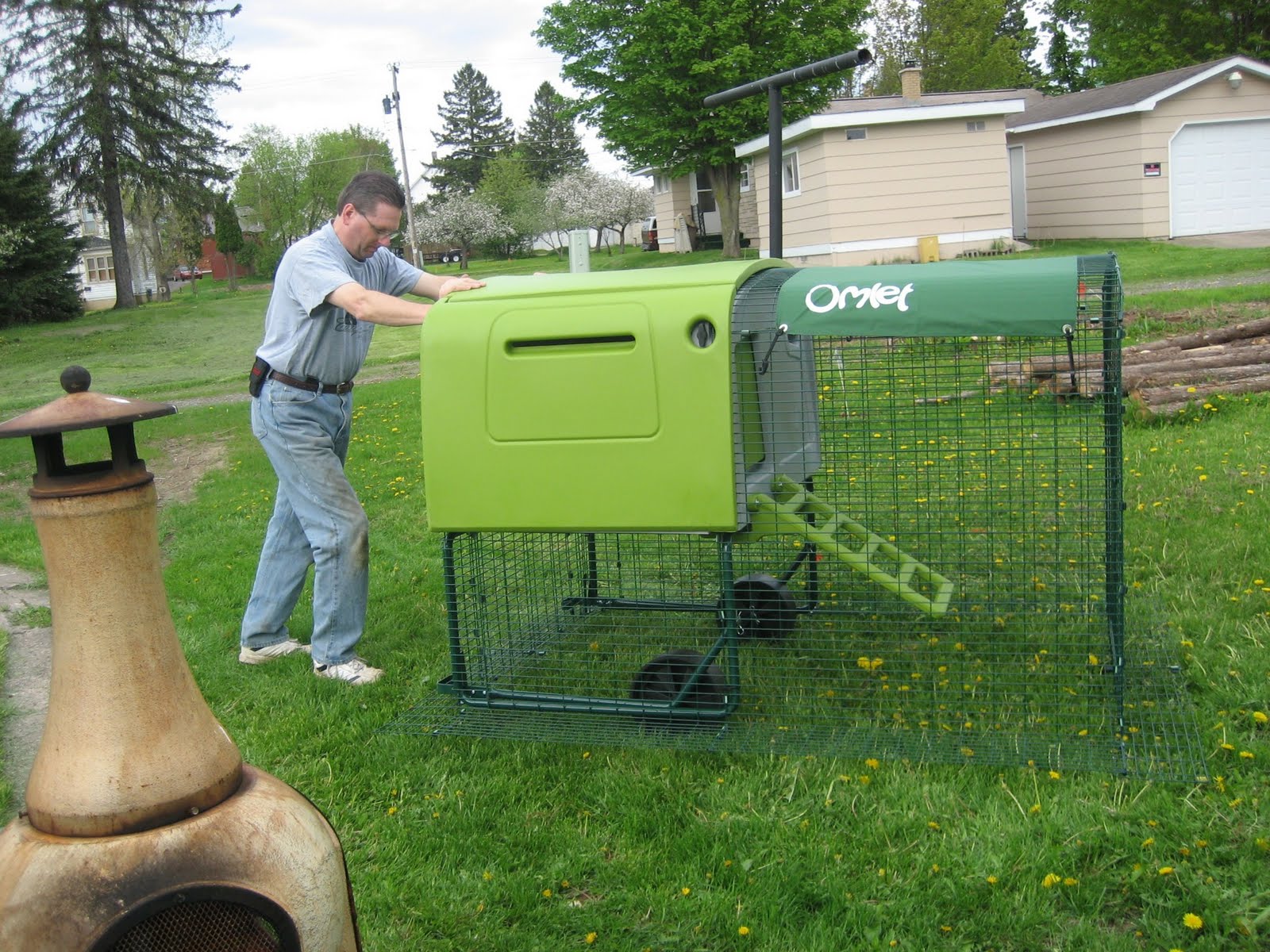
One of the best features of this tractor is the ten inch skirt around the run.  It is literally fox, and other rodent, proof.  They cannot dig underneath it to get at the chickens.  Another great feature is that there are two drawers that we line with newspaper for the droppings that go under the roosting bars.  Makes cleaning a breeze.  There's also easy, outside access to the nesting box, and the front door slides open and shut from the outside.  The handle for the front door stores away, and animals can't get at it.

Installing the roof and back access panel.
Installing the roosting bars.
The roof slides forward, and the back panel comes out for easy access to clean.  The beauty of the unit being plastic is that it can simply be washed and scrubbed down in every nook and cranny.  It's also properly vented so the air does not become stagnant.  Chickens like to take dust baths, and that adds to the pollution inside a coop if it is not properly vented.  Also, chickens are prone to some sort of red mites that can make them quite sick.  Those mites can't live in this coop - especially after cleaning.

Moving the tractor.
Installing small fence.
Omlet says that this tractor can house up to ten chickens.  Maybe in theory, but I don't know if I would want to put more than six in it.  If they were never let out of the run, I wouldn't put more than the three we have in it. So, we may add another three chickens eventually.

Moving the Cube is not as easy as Omlet makes it out to be.  Yes, the wheels are large, but there's nowhere to grab onto for control.  If the yard was perfectly smooth, then it would be much easier, but our yard has small divots all over it.  The chickens dig additional holes as well.  I decided to add a couple of handles to the back panel to make it easier to balance on the two wheels, and to pull it if necessary.  Makes moving a bit easier.

Completed Cube with feeder & waterer
One thing we read about was that since the spacing on the fence that comes with the Cube is 2" X 4", raccoons and other such animals can reach in, grab a chicken, and tear it to pieces.  We didn't want that to happen, so we went to the big box store and picked up some light fencing that is just 1/2" square and two feet tall.  We installed that all the way around the base of the run, and have not had an issue whatsoever.  Although, I must say that since I installed the six foot fence around the yard, we haven't even seen rabbits back there.  So, I guess that's a double deterrent.

All in all we're quite happy with the Cube.  Even though it's supposed to be insulated against the cold, we've decided we're going to keep the chickens in our wood room in the house for the winter.  It gets very cold up
 here, and we don't want any chickens freezing their toes or combs off.

The chickens arrived healthy & sound
Wondering what's up.
Well, around June 22, early in the morning, I got a call from the local Post Office telling me that the chickens had arrived.  We opted to purchase them through Omlet.  They were guaranteed to have been raised organically, and were within four to six weeks of laying.  I believe they came from a grower in Ohio.  I was out of town, so Sheri had to go get them.  It wasn't a large box, so was rather easy for her to handle.  I reminded her to document it in pictures.

Checking out their new home.
Beulah, Henrietta, & Nellie.
First eggs.  Rather small.
Granddaughter helping collect
She introduced them to their new home, and they took right to the food and water.  The first bag of feed came from Omlet, but it wasn't soy free.  So, I ordered some soy-free layer mix from Super Soy, a subsidiary of CFS.  (Funny how I would get a soy-free product from a soy processing plant.)  It runs only $16/bag, but I have to pick it up in Brodhead, WI.  As I was only about 20 minutes from there all Summer, that wasn't a problem, but now I think I'm going to have to find a different supplier, or get in with a group of people and order a pallet at a time so it's not so expensive to ship.  Three chickens don't go through a lot of feed - especially since we feed them tomatoes, watermelon, table scraps, and they're able to free range.

Searching for treats (bugs, worms, etc.)
Watching the chickens.
We affectionately named the chickens Henrietta, Beulah, and Nellie (for nervous Nellie - she squawks the most when picked up).  Within two weeks, Sheri found two eggs in the nesting box.  But it was at least another four or five weeks before there were more.  I guess one of them was farther along than the others.  They're now laying regularly one egg each per day.  Our oldest son and his family were here for two weeks in August, and our granddaughter, Sadie, loved to go check for eggs.  She was nervous around the chickens at first, but then warmed up to them.  They're very friendly birds, and love to follow us around the garden.  If we're picking tomatoes, and not watching out, Henrietta will come and take them right out of the bucket.  They LOVE tomatoes!

Many more adventures to come.

Update:
If you are not in a position to purchase one of these Eglu Cube tractors, you can build your own coop. There are lots of resources for plans online. Here are a few:
1. Building a Chicken Coop
2. How to Build a Chicken Coop with Easy Step-by-Step Instructions
3. Easy D.I.Y. Chicken Coop Plans